Quick Summary
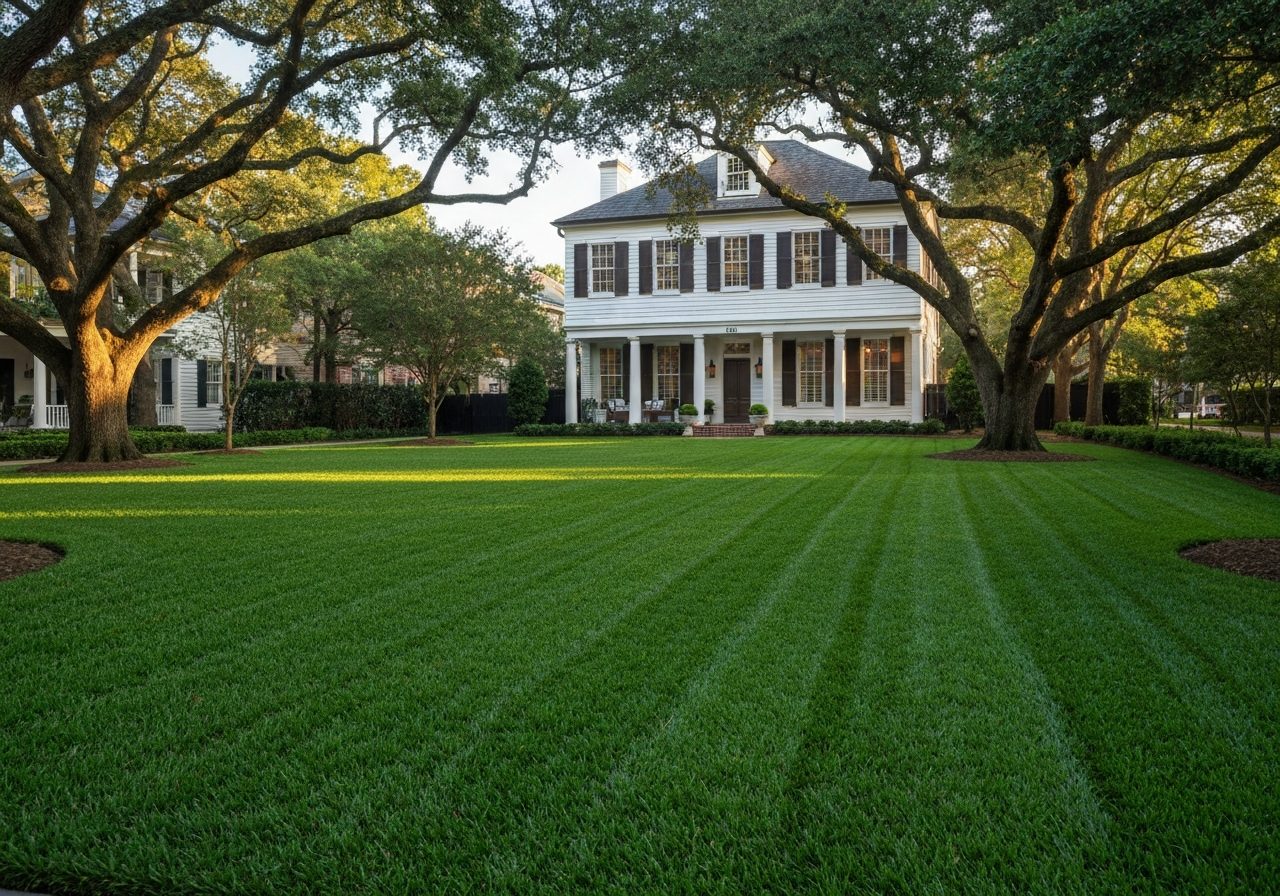
St. Augustine grass turns brown in New Orleans for five common reasons, and the fastest way to tell them apart is to look at where the browning started rather than what it looks like now. Chinch bug damage shows up first along driveways, sidewalks and storm drains where heat radiates off pavement. Large patch appears as circular patches in low airflow corners near fences and shrubs, and the leaves pull away from the crown with little resistance. Take-all root rot begins as a general yellowing and thinning before any brown appears. Big Easy Sod diagnoses browning lawns across New Orleans, Metairie, Kenner, Slidell and the Northshore, and separates the problems that respond to treatment from the ones that need resodding.
Last Updated: August 2026
On this page
- Is your St. Augustine dead or just dormant?
- What does chinch bug damage look like in a New Orleans lawn?
- How do you tell large patch from ordinary drought stress?
- Why does take-all root rot look like every other problem?
- Why is your St. Augustine yellow rather than brown?
- Why does St. Augustine keep dying under live oaks?
- When does browning mean replacement instead of treatment?
- Frequently Asked Questions
Brown St. Augustine in a New Orleans yard almost always traces back to one of five causes: winter dormancy, chinch bugs, large patch, take-all root rot, or simple drought stress. They look similar enough from a porch that homeowners routinely treat the wrong one, and a fungicide applied to insect damage costs money and buys nothing. Big Easy Sod works on St. Augustine lawns across Orleans and Jefferson parishes and up onto the Northshore, and the diagnosis usually comes down to three things: where the browning started, whether the blades pull loose from the crown, and what the weather did in the two weeks before it appeared.
The point of getting this right is that the treatments have nothing in common. One problem is solved with water, one with an insecticide, one by changing when you irrigate, and one cannot be solved at all in a bad year and simply has to be grown out or replaced. The sections below work through each in the order a lawn in this climate is most likely to hit them, and if you want the same walkthrough for the whole yard rather than one patch, a lawn health assessment covers soil, drainage and grass condition together.
Is your St. Augustine dead or just dormant?
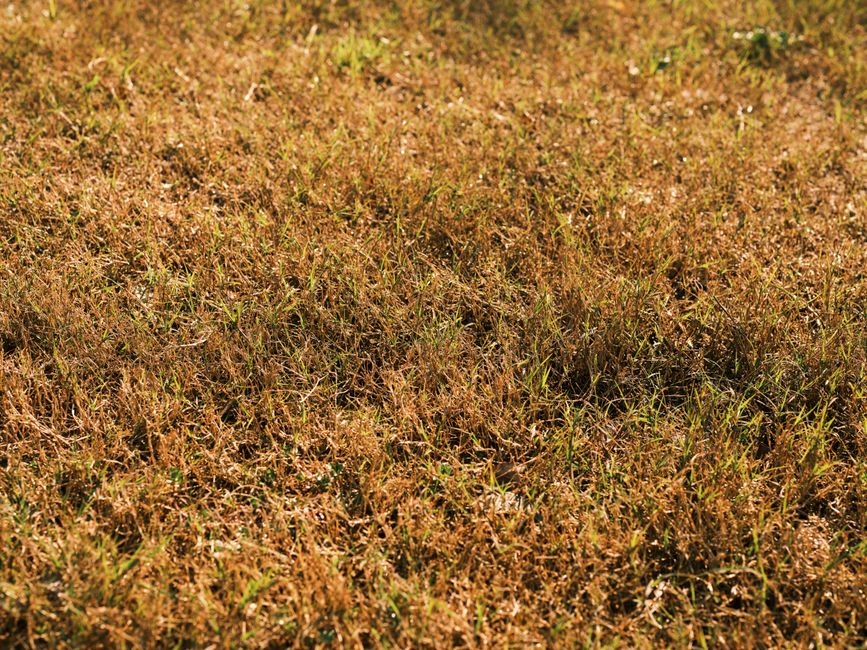
Dormant grass is brown from the top down and still firmly rooted. St. Augustine slows almost to a stop under sustained cool weather and shorter days, with soil around 55 degrees Fahrenheit a useful guide rather than a hard switch. Blades turn brown while the plant lives off its roots.
Treat the tug test as a strong clue rather than proof, because turf that died recently can still hold for a while. What easy lifting reliably tells you is that the roots or crown have failed, not what killed them. The test matters most between December and March, when a browning New Orleans lawn is usually doing exactly what it is supposed to do. St. Augustine grows best between 80 and 95 degrees, so a brown January lawn is not a problem to solve. Green returns as soil temperatures climb back through spring, and a lawn that has greened up everywhere except a few defined patches is telling you those patches have a separate cause.
Outside the cold months, run the same tug test anyway, because it splits your remaining possibilities in half straight away:
- Blades pull off the stem easily while the runner stays put. The base of the leaf sheath has rotted, which points at large patch.
- The whole plant lifts, roots and all, with almost nothing holding it. The roots are gone, which points at take-all root rot or grubs.
- The grass stays anchored but the blades are curled, shriveled and straw colored. Nothing is eating the roots, so this is chinch bugs or genuine drought.
What does chinch bug damage look like in a New Orleans lawn?
Chinch bug damage looks exactly like a lawn nobody watered. The LSU AgCenter reports the insects run about an eighth of an inch long, feeding through a slender beak that injects a toxin and draws out plant juices. Blades curl, shrivel and brown, which is why heat stress gets blamed instead.

The detail that separates them is location. The LSU AgCenter notes that chinch bug symptoms appear first in the spots where heat radiates hardest, meaning the strips of lawn beside storm drains, sidewalks and driveways. Drought browns a lawn broadly, worst on high ground and thin soil. Chinch bugs brown it in a band that hugs the concrete and then spreads outward into the yard.
If the browning started against the driveway apron during a hot dry stretch and watering has not brought it back within a week, treat the insects rather than the irrigation. Keep in mind that watering a chinch bug problem does not fix it but does hide the evidence, which is how a small patch becomes half a front yard by August. The same heat pattern is worth reading alongside the way summer heat and watering interact in this climate, because the two problems arrive in the same weeks and get confused constantly.
How do you tell large patch from ordinary drought stress?
Large patch is circular, drought is not. The disease comes from the soilborne fungus Rhizoctonia solani, and the LSU AgCenter reports Louisiana sees it most often in spring and fall, when nights sit between 60 and 75 degrees. Drought follows the dry spots in a yard. Large patch draws rings.
Three signs confirm it, and all three are quick to check:
- A yellowish cast at the leading edge of the patch, which is the specific color St. Augustine shows. Centipede grass shows a purple to reddish edge instead.
- Leaves that separate from the crown with a gentle pull, because the fungus rots the base of the leaf sheath rather than killing the whole plant.
- Patches that start where air does not move, so along fence lines, behind shrub beds, and in the corners of a yard that stay damp after rain.
Large patch usually does not kill the grass outright, which is genuinely good news, and the most useful change most homeowners can make is to stop watering in the late afternoon. Irrigating early in the morning lets the blades dry before nightfall and takes away the wet overnight conditions the fungus needs. Several other diseases show up in this climate with their own signatures, and the differences between the fungal problems that circulate through New Orleans lawns are worth knowing before reaching for a fungicide.
Why does take-all root rot look like every other problem?
Take-all root rot starts as general yellowing and thinning rather than a defined patch, which is why it gets misdiagnosed. The LSU AgCenter calls it a soil-borne fungal disease that has become a major concern in Louisiana St. Augustine lawns, and notes the symptoms can resemble chinch bug damage.
The difference is underground. Take-all severely reduces the root system, so affected turf lifts away in sheets with short, dark, brittle roots underneath. Chinch bug damage leaves the roots intact. The LSU AgCenter’s management guidance is unglamorous and works over seasons rather than days: water as needed rather than on a fixed schedule, aerate to reduce soil compaction, and mow at the correct height, which is roughly two and a half to three inches for St. Augustine. Getting that wrong is common, and the heights and cutting frequency that suit each season here are worth setting before the next stressful summer. Repeated stress is what turns this disease destructive, so anything that reduces stress is treatment.
Here is the whole differential in one place.
| Cause | Where it starts | Shape | What the tug test does | Season |
|---|---|---|---|---|
| Dormancy | Everywhere at once | Whole lawn, even | Holds firm | Winter |
| Chinch bugs | Beside pavement and storm drains | Bands that spread outward | Holds firm, blades curled | Hot, dry stretches |
| Large patch | Low airflow corners, fence lines | Circular, yellow leading edge | Leaves slip off the crown | Spring and fall |
| Take-all root rot | No clear starting point | Yellowing first, then irregular | Whole plant lifts, roots gone | Wet spells, worse under stress |
| Drought | High ground and thin soil | Follows the dry spots | Holds firm | Any dry stretch |
Why is your St. Augustine yellow rather than brown?
Yellow is a different signal from brown, and usually a less serious one. Even yellowing across a whole lawn, with blades still soft and roots still holding, generally points to a nutrient availability problem rather than disease or insects. In Louisiana that often traces back to soil chemistry.
Watch the pattern. Yellowing that appears on the newest growth first, while older blades below stay greener, is a classic iron availability signature and is common where soil pH has drifted upward. Yellowing that starts on older growth and works up tends to be nitrogen. Yellowing in defined patches with a firm edge is more likely the early stage of take-all than a feeding problem, which is the case worth catching early.
Because these get treated so differently, a soil test before a fertilizer purchase is one of the few pieces of lawn advice that reliably saves money. Correcting an underlying soil problem also has to happen before any new grass goes down, which is why ongoing maintenance and lawn care work starts with what is in the ground rather than what is on it.
Why does St. Augustine keep dying under live oaks?
St. Augustine is the most shade tolerant common Southern lawn grass, and it still needs roughly four to six hours of sun a day. A dense mature live oak canopy usually falls below that, and the tree also wins the competition for water and nutrients in the top few inches of soil.
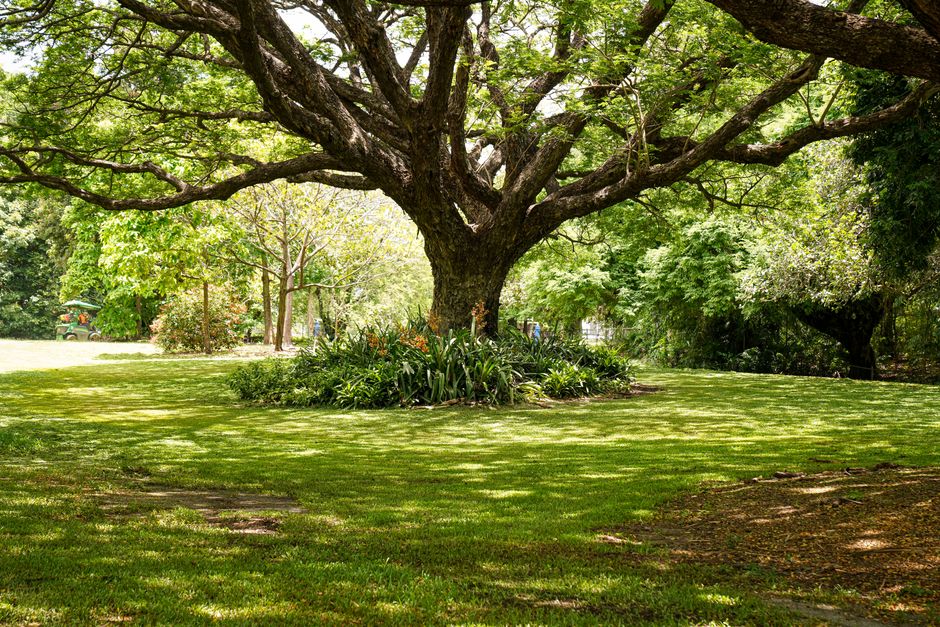
This is the one browning problem on the list that is not really a lawn problem. Where the canopy has closed up, replanting the same grass in the same spot produces the same outcome, usually within two seasons, and homeowners often repeat the cycle two or three times before changing approach. The workable options are to thin the canopy where an arborist says it is safe, to switch that zone to a more shade tolerant grass or a shade tolerant St. Augustine cultivar, or to stop fighting it and convert the area to beds, mulch or ground cover.
Bare ground under a tree is a different repair job from a diseased patch out in the open, and the approach for bare and patchy areas across a New Orleans yard depends heavily on whether the underlying cause has actually been removed.
When does browning mean replacement instead of treatment?
Treatment stops being worth it when the roots are gone or the cause cannot be removed. As a working rule, a lawn more than half dead, one that has lost its roots to take-all or grubs, or one that has failed twice under the same canopy is not a treatment case.
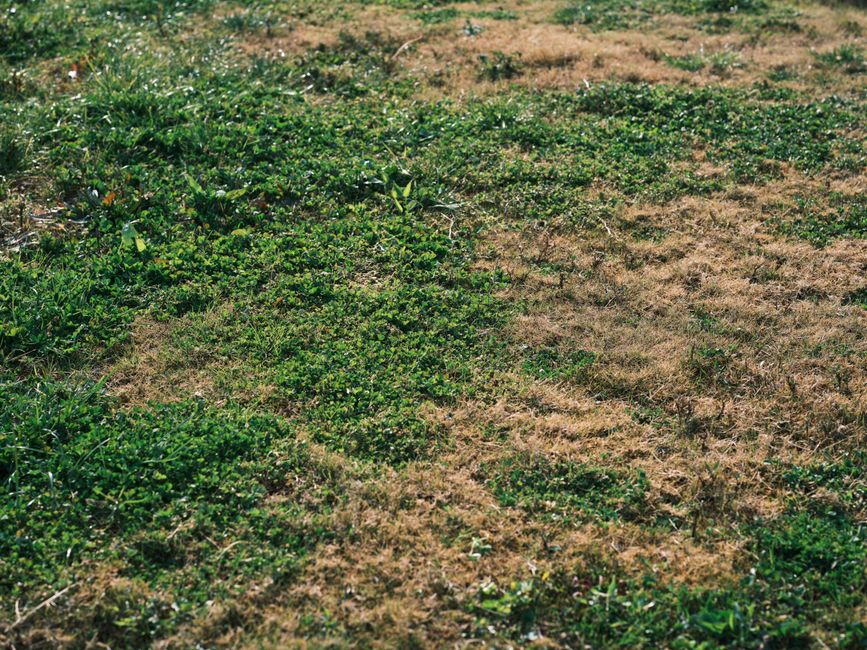
St. Augustine spreads by above ground runners, so a lawn with healthy grass on the edges of a dead area can close that gap without any help, given water and a growing season. That is the argument for patience over a rush to resod. The argument the other way is time. Filling a large dead area by runner alone can take a full season or more, and bare soil in this climate does not stay bare, it fills with weeds that then have to be dealt with separately.
Where the dead area is defined and the surrounding lawn is genuinely healthy, replacing just the failed section costs far less than redoing a yard and matches into existing grass without a visible seam. Where the cause was soil rather than the grass itself, that has to be corrected first or the new sod repeats the failure, and watering a fresh lawn through its rooting weeks decides whether any of it takes. Big Easy Sod supplies and installs St. Augustine sod grown for Gulf Coast conditions, and the honest version of this conversation often ends with a recommendation to wait a season rather than buy anything.
Frequently Asked Questions
How long does brown St. Augustine take to come back after watering?
If the cause was simple drought and the roots are alive, color usually returns within seven to ten days of deep watering. No improvement after two weeks means the problem is not water, and the next things to check are chinch bugs and root health.
Will brown patches in St. Augustine spread to the rest of the lawn?
Large patch and take-all root rot both spread, and chinch bugs move outward from where they started. Dormancy and drought browning do not spread in the same sense, they simply appear wherever conditions are worst.
Can I put fungicide on brown grass to be safe?
No. Fungicide does nothing for chinch bugs, drought or dormancy, which are three of the five most common causes, so applying it before identifying the problem usually just delays the real fix by a couple of weeks.
Is it normal for St. Augustine to go brown every winter in New Orleans?
Yes. St. Augustine goes dormant through sustained cool weather and shorter days, turning brown or tan until spring. The grass is alive, and a lawn that stays firmly rooted through winter is behaving normally.
Why did my brand new sod turn brown within a couple of weeks?
New sod browns from transplant stress and inconsistent watering far more often than from disease, because the roots have not yet reached soil moisture and the pieces dry from the edges inward. This is a watering problem in almost every case, not a reason to replace the sod.
Does mowing height affect browning?
It does. The LSU AgCenter puts St. Augustine mowing height at roughly two and a half to three inches, and cutting shorter than that reduces the root system, dries the soil surface faster, and makes every other problem on this list worse.
Who can diagnose a browning lawn in the New Orleans area?
Big Easy Sod assesses browning St. Augustine lawns across New Orleans, Metairie, Kenner, Gretna, Slidell, Mandeville and Covington, and identifies whether the yard needs treatment, time, or replacement before anything is sold.
Get the browning identified before you treat it
Guessing at a brown lawn is expensive, because four of the five causes here respond to nothing the other four need. Call Big Easy Sod at (504) 608-3321 to have the yard looked at properly, or request a quote for the work if you already know the grass is gone. The team covers Greater New Orleans, Jefferson Parish and the Northshore, and handles diagnosis, treatment and resodding without handing you between three companies. If you are still working out which grass belongs in the yard at all, the range of sod grown and installed locally is a useful place to start.