
Last Updated: November 16, 2026
Table of Contents
- Why do mushrooms show up in a lawn after rain?
- Are mushrooms bad for your lawn?
- Should you mow, rake or pick lawn mushrooms?
- What does a fairy ring look like in a Louisiana lawn?
- Are lawn mushrooms dangerous for kids and pets?
- How do you get fewer mushrooms in the yard?
- Frequently Asked Questions
Quick Summary: Mushrooms are the fruiting part of soil fungi that feed on buried roots, stumps and thatch, and they pop up after heavy rain. Most do no harm to the lawn and fade when the weather dries out or turns colder. Treat them as poisonous: remove and destroy them, as UF/IFAS advises, and keep them away from children and pets.
Why do mushrooms show up in a lawn after rain?
Most of the organism lives underground. Clemson University’s guide to mushrooms in lawns says these fungi feed on decaying organic matter such as old roots, stumps and thatch, and that mushrooms seem to sprout overnight after wet weather. Texas A&M AgriLife adds that after heavy rain, the fungus rapidly grows mushrooms to release spores.
So a crop of mushrooms after a storm is usually not a sign of something new in the yard. It is the visible part of a fungus that has been breaking down buried material underground. Big Easy Sod installs and maintains lawns across Greater New Orleans, and this guide pulls together what university extension offices say about the mushrooms that follow a wet spell.
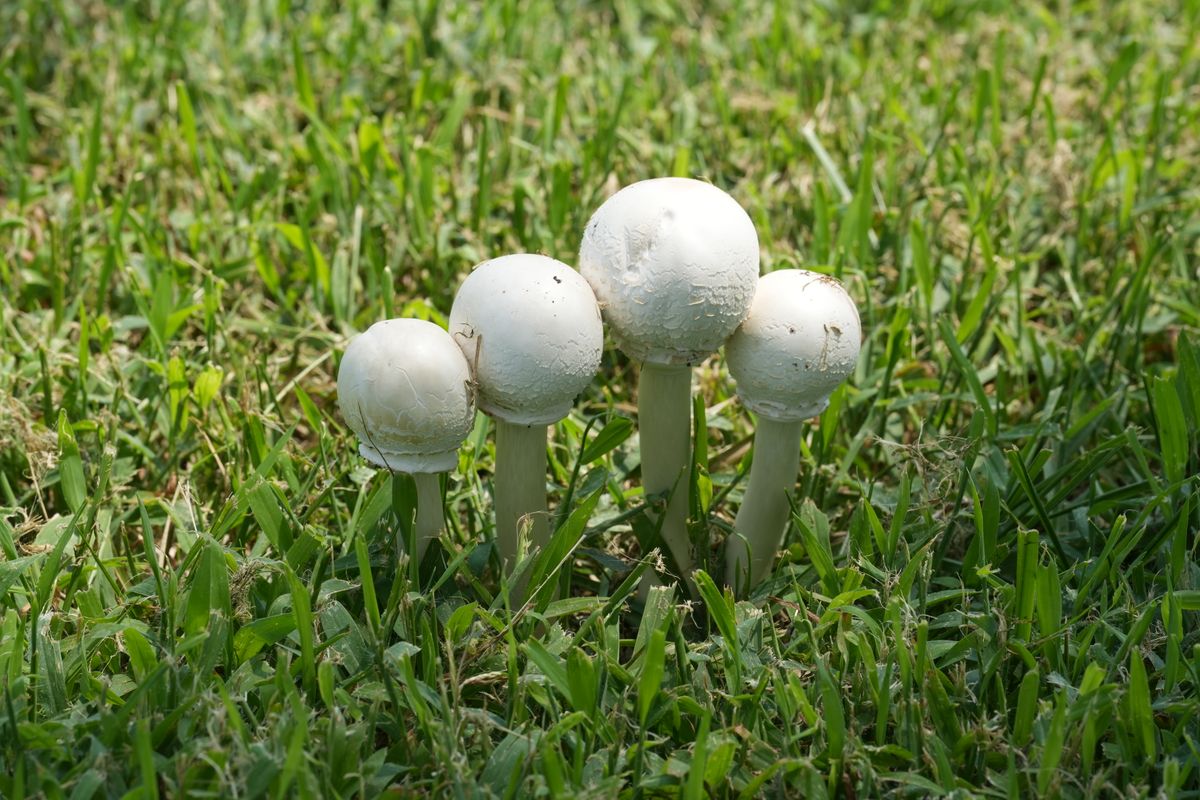
Are mushrooms bad for your lawn?
Usually not. Clemson says most mushrooms do not damage the lawn, but fairy ring fungi can become a problem. Clemson also says fairy ring fungi are not plant parasites. Clemson also notes that mushrooms disappear on their own when the weather becomes dry or turns colder, so mushrooms that come up in fall may not last once it turns cold.
Picking them is mostly cosmetic. As Texas A&M puts it, you can pick mushrooms, but it will not stop them coming back, because they are just the fruiting part and most of the organism lives underground. Extension sources point instead to the buried material the fungus feeds on and to wet conditions, covered further down.
Should you mow, rake or pick lawn mushrooms?
Extension offices do not fully agree, which is worth knowing before you fire up the mower. UF/IFAS Extension in Florida says proper regular mowing helps suppress mushroom rings by chopping them up. UC Agriculture and Natural Resources in California says not to mow them, because mowing spreads the fungus, and to pick them out instead.
| Extension source | What it advises |
|---|---|
| LSU AgCenter | Mushrooms in a fairy ring can be raked and disposed of; no effective chemical control for homeowners |
| UF/IFAS (Florida) | Treat them as poisonous, remove and destroy them; regular mowing helps suppress rings |
| UC ANR (California) | Do not mow them; pick them out and reduce irrigation |
| Texas A&M AgriLife | Picking will not stop them; fungicide would also likely harm beneficial soil fungi |
LSU AgCenter says to rake and dispose of them, UF/IFAS says to remove and destroy them, and UC ANR says to pick them out, so all three agree on getting them out of the lawn. UF/IFAS goes further and says to treat them as poisonous and destroy them, which matters most in a yard where children or pets play.
What does a fairy ring look like in a Louisiana lawn?
Look for a circle or arc. Clemson describes fairy rings as areas of dark green or dying grass that are circular or arc-shaped, with the dark green caused by nutrients released as the fungi break down organic matter. LSU AgCenter’s fairy ring page says mushrooms may appear in the ring during wet, humid conditions.
The damage, when there is any, is dryness. Clemson says fairy ring fungi can cause localized drought stress because their strands make the soil repel water. LSU AgCenter adds that rings can last several years, can disappear and reappear, and that aerification followed by intense irrigation may help break up the water-repellent zone. Our overview of common lawn diseases in New Orleans also covers fairy ring.
Are lawn mushrooms dangerous for kids and pets?
Assume yes. UF/IFAS says to consider lawn mushrooms poisonous and to remove and destroy them so they are not eaten by people or pets. UC ANR says many species are poisonous and only an expert can tell edible from poisonous. Texas A&M says the common white false parasol can cause extreme digestive problems if eaten.
Texas A&M also advises washing your hands after removing mushrooms, especially before touching your eyes or face. If you suspect someone in the family has eaten one, it says to contact poison control. If it is the dog, call your veterinarian.
How do you get fewer mushrooms in the yard?
Start with what the fungus feeds on. UF/IFAS says fairy ring fungi use buried organic matter such as tree stumps, lumber and leaves, and that this material can persist for many years. UC ANR in California adds that too much water, poor drainage or too much shade favor mushrooms, so standing water and soggy low spots are worth fixing.
Thatch matters too. LSU AgCenter says excessive thatch provides a suitable environment for fairy ring fungi and that dethatching may be necessary, but it also notes that lightly irrigated, under-fertilized lawns are more vulnerable to fairy rings, so cutting water back hard is not the answer for a ring. Our aeration and dethatching service handles that part, and our guide on when to aerate a lawn in Louisiana explains the timing.
Skip the fungicide. LSU AgCenter says there is no effective chemical control available for homeowners, and Texas A&M says treating the fungus would likely harm beneficial soil fungi too. If water stands in part of the yard after every storm, our guide to sod in flood-prone New Orleans yards covers the drainage side. For an outside opinion on a soggy or patchy lawn, request a free quote or call (504) 608-3321. Our sod maintenance and lawn care services also include lawn health assessments.
Frequently Asked Questions
Do mushrooms mean my lawn has a disease?
Not usually. Clemson says most mushrooms do not damage the lawn. A circle or arc of dying or dark green grass around them is the pattern Clemson describes for fairy ring.
Will mushrooms keep coming back in the same spot?
They can. LSU AgCenter says fairy rings can last several years and can disappear and reappear, and UF/IFAS says the buried material they feed on can persist for many years.
Is a fungicide worth trying?
LSU AgCenter says there is no effective chemical control available for homeowners. Removing the mushrooms, cutting back thatch and fixing standing water are the steps extension offices point to instead.