
 Mar 30, 2026
The Importance of Fall Aeration
-
 By Admin
As the vibrant colors of summer fade and the cool breeze of fall begins to se...
Read More

Monday - Saturday : 9:00 AM to 6:30 PM


Call Us Now: 504-608-3321


St. Augustine grass is the most popular lawn choice in the New Orleans area for good reason. It loves heat, handles humidity, tolerates some shade, and thrives along the Gulf Coast. But it also has specific vulnerabilities that hit harder here than anywhere else in the country. Chinch bugs, large patch fungus, flooding damage, and nutrient deficiency all thrive in a subtropical Louisiana climate. This guide covers every common problem St. Augustine grass faces in New Orleans, how to fix each one, and how to maintain a lawn that stays green and healthy through our long, brutal summers.
Walk through any neighborhood in Metairie, Kenner, Mandeville, Slidell, or Mid-City and you’ll see St. Augustine grass everywhere. There’s a reason for that. This grass was practically built for conditions like ours, warm temperatures most of the year, intense summer heat, high humidity, heavy rainfall, and the salt air that rolls in off Lake Pontchartrain and the Gulf.
St. Augustine forms a thick, dense, carpet-like turf with broad, flat blades and a dark green color that holds up even in the heat of a Louisiana August. It spreads by stolons, horizontal stems that creep across the soil, which means it fills in gaps and bare spots over time without needing to be reseeded.
It can handle more shade than Bermuda grass, which matters in a city full of live oaks. And it recovers reasonably well from the kind of water stress that comes with summer droughts followed by sudden downpours.
None of that means it’s problem-free. The same warm, wet conditions that make St. Augustine thrive in New Orleans also create the perfect environment for the specific pests and diseases that attack it. Understanding those threats. Knowing how to respond before they get out of hand is the difference between a lawn you’re proud of and one that’s patchy and struggling.
If you have St. Augustine grass in the New Orleans area and you notice irregular patches of yellowing or browning grass spreading outward from the sunniest parts of your yard, chinch bugs are the first thing to suspect. They’re the single most destructive pest for St. Augustine lawns in the South, and New Orleans summers give them ideal conditions to thrive.
Chinch bugs are tiny. Adults are only about a fifth of an inch long, roughly the size of a grain of rice. Adults have black bodies and white wings folded flat across their backs with orange legs; young nymphs are reddish-orange with a white stripe across their backs.
They live in the thatch layer at the base of the grass and feed by piercing the grass blades and sucking out the plant fluids, injecting a toxin as they feed that prevents the grass from taking up water. The damage looks like drought stress at first, which is why people often assume their lawn just needs more water.
Watering more does nothing to fix a chinch bug problem.
How to check for chinch bugs
Push a coffee can with both ends removed into the soil at the edge of a damaged area and fill it with water. Check for a few minutes, chinch bugs will float to the surface. For a 4-inch diameter can, finding an average of more than 2 bugs per sample indicates a damaging population. Take several samples around the damaged area, not just one spot.
When chinch bugs are worst in New Orleans
Peak damage season is May through September. They love hot, dry conditions and full-sun areas. Lawns that are over-fertilized with nitrogen, under-watered, or have excessive thatch are significantly more vulnerable.
How to treat a chinch bug infestation
Insecticides containing bifenthrin or imidacloprid are commonly used options. Apply in the late afternoon when the soil is moist, never during the heat of the day. Treat the damaged area plus a buffer zone of healthy grass around it, and water lightly after application to move the product into the thatch.
Important resistance note
According to a 2025 update from the University of Florida’s Department of Entomology, chinch bugs have documented resistance to pyrethroids (the class that includes bifenthrin) and neonicotinoids (the class that includes imidacloprid) in many areas of the South.
If a first application doesn’t produce results within a few weeks, rotate to a different chemical class rather than reapply the same product. Contact your local LSU AgCenter extension office for current product recommendations specific to the New Orleans area.
Prevention
Keep thatch below half an inch. Avoid high-nitrogen fertilizer applications in summer. Maintain mowing height; don’t cut the grass too short, which stresses it and makes it more attractive to chinch bugs.
The disease commonly called “brown patch” on St. Augustine grass is now correctly called large patch in the turfgrass disease literature. It’s caused by Rhizoctonia solani, a soilborne fungus that is considered the most serious turfgrass disease in Louisiana, according to the LSU AgCenter.
Large patch on St. Augustine produce roughly circular patches of yellowing and browning grass that can range from about a foot in diameter to several feet across. The disease attacks the base of the leaf sheaths near the soil surface, causing a rot that severs the connection between the leaf and the stolon.
A telltale diagnostic test: walk to the edge of an affected patch and gently tug on a symptomatic grass blade. If it separates cleanly from the plant at the base, a large patch is the likely culprit. The blade will often have a dark, rotted base with a faint rotten smell.
When large patch is worst in New Orleans
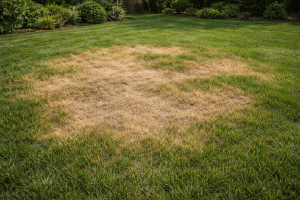 The LSU AgCenter reports that large patch develops most rapidly when nighttime temperatures fall between 60 and 75°F and daytime temperatures don’t exceed 85–90°F, conditions that describe most of our fall and spring. It is not typically active during the hottest weeks of summer.
If you see circular brown patches appearing as your lawn cools down in September or October, or again as it greens up in spring, large patch is a strong suspect.
What triggers it
Extended periods of leaf wetness, especially from late-afternoon or evening irrigation that leaves the grass canopy wet all night, are the primary driver. Excessive nitrogen application in fall, when the grass is slowing down, produces lush, soft growth that the fungus attacks easily. Thick thatch and poor airflow through the canopy make things worse.
How to treat large patch
Fungicides containing azoxystrobin, propiconazole, or myclobutanil are effective options listed by the LSU AgCenter. Apply at the first sign of infection rather than waiting for large patches to develop. Two applications spaced two to three weeks apart are often needed during favorable conditions. Always check that the product label specifies use for large patch or Rhizoctonia diseases in warm-season grasses.
The most effective prevention
Switch all irrigation to early morning, finishing by 9 a.m. so the canopy dries completely before nightfall. Avoid nitrogen fertilizer applications after August. Maintain mowing height at 2.5 to 3 inches to allow airflow. Dethatch if your thatch layer has built past half an inch.
Gray leaf spot is a separate fungal disease caused by Pyricularia grisea. While large patch favors cooler, wetter weather in fall and spring, gray leaf spot is a summer disease. According to the LSU AgCenter, gray leaf spot in Louisiana is typically observed from midsummer through early fall, with optimal development when temperatures are in the 82–90°F range, exactly what New Orleans summers deliver.
The symptoms are distinctive: small, oval lesions on the grass blades with dark brown or purple margins and tan to gray centers. Under humid conditions, you may see a grayish, fuzzy growth in the center of active lesions. Under heavy pressure, the blades yellow and the grass thins out, sometimes looking like a nutrient deficiency at first glance.
Gray leaf spot is almost always made worse by excessive nitrogen fertilization in summer. A high-nitrogen application in July followed by a wet, humid week is practically a formula for an outbreak. Shaded, poorly drained areas are especially vulnerable.
Treatment: The same fungicides effective against large patch also cover gray leaf spot. The more important intervention is stopping nitrogen applications between June and August. Raise mowing height slightly in affected areas to aid recovery, and water only in the early morning.
These three problems can all look similar from a distance, which leads to misdiagnosis and money spent on the wrong treatment.
| Chinch Bugs | Large Patch | Gray Leaf Spot | |
|---|---|---|---|
| Pattern | Irregular patches expanding from sunny areas | Roughly circular, often with active reddish-brown edge | Diffuse thinning; lesions visible on individual blades |
| Peak season in N.O. | May–September | September–November; February–April | July–September |
| Optimal temp trigger | Hot, dry summer conditions | Nights 60–75°F | Daytime 82–90°F |
| Grass blade appearance | Yellowing first, progressing to brown | Base of blade rots; blade pulls free cleanly | Oval lesions with dark margins; gray centers |
| At soil level | Visible insects in thatch | No insects; rotted base of pulled blades | No insects; no basal rot |
| Response to watering | Gets worse (doesn’t fix the problem) | Worsens under wet conditions | Worsens under wet, humid conditions |
| Diagnostic test | Float test with water-filled coffee can | Tug test: blade pulls free at the rotted base | Look for lesions on individual blade surfaces |
Not sure what’s wrong with your lawn? Big Easy SOD serves New Orleans, Metairie, Kenner, Mandeville, Covington, Slidell, and the surrounding area. Call us at 504-608-3321 for a free consultation, or request a free estimate online.
Most lawn care guides don’t spend much time on flood recovery because most of the country doesn’t need it. Here, it’s a real seasonal concern. New Orleans averages approximately 62 inches of rain per year, nearly double the U.S. average of 38 inches. Drainage can be slow in low-lying areas, and even a moderate storm can leave parts of a yard underwater.
St. Augustine handles brief flooding better than centipede grass, though it’s more sensitive than Bermuda grass or bahia grass, which the University of Georgia Extension notes are the most flood-tolerant warm-season turfgrasses. Prolonged submersion is more damaging in summer, when the grass is actively growing and consuming oxygen, than in cooler months when growth is slower.
Signs of flood damage: Yellowing, wilting, or browning that shows up a few days after floodwater recedes. In severe cases, the grass may pull up easily because the roots have rotted. You may also see algae or slimy deposits on the soil surface.
What to do immediately after flooding:
Recovery: For flooding that was brief and occurred in moderate temperatures, most St. Augustine lawns recover with normal care over a few weeks. For extended flooding in summer heat, expect a longer recovery window, and areas where the roots were fully lost will need resodding.
For a more detailed recovery guide: How to Fix St. Augustine Grass After Flooding
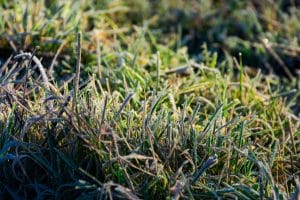
Yellowing grass with no visible pests and no fungal lesions is almost always a nutrient problem. The three most common in the greater New Orleans area are nitrogen deficiency, iron deficiency, and potassium deficiency, and each looks a bit different.
How to address nutrient deficiencies in Louisiana:
Louisiana’s soils, particularly in older New Orleans neighborhoods, are often clay-heavy. Clay compacts easily under foot traffic or equipment. Compacted soil reduces pore space, meaning less oxygen reaches the roots, water drains more slowly, and fertilizer becomes less effective.
Core aeration, pulling plugs of soil out of the ground, is the right tool for addressing compaction in clay soils. The best time to aerate St. Augustine in New Orleans is late spring or early summer, when the grass is actively growing and can fill in the holes quickly. A top dressing of compost after aeration improves soil structure over time.
Thatch is the layer of dead grass stems, roots, and organic matter that accumulates between the soil surface and the green blades. A thin layer, under half an inch, is beneficial.
But St. Augustine builds thatch quickly, and once that layer exceeds half an inch, it starts blocking water and fertilizer, creating a habitat that chinch bugs love, and holding moisture against the canopy in a way that promotes fungal disease.
Dethatching St. Augustine should be done carefully; this grass can be damaged by aggressive mechanical dethatching. A light power rake or vertical mower on a high setting works best, done in late spring when the grass is actively growing and can recover quickly.
St. Augustine needs about 1 to 1.5 inches of water per week during active growth. New Orleans rainfall covers much of that, but it comes in heavy bursts rather than steady amounts, and dry stretches of a week or two are common from July through September.
Signs of under-watering
 Grass blades fold lengthwise and take on a blue-gray tinge before turning brown. Footprints stay visible in the lawn longer than usual because the grass doesn’t spring back.
Signs of over-watering
The lawn feels spongy underfoot. Moss or algae appears on the soil surface. Fungal problems become recurring despite treatment.
The right approach is deep and infrequent: irrigate long enough to deliver about three-quarters of an inch per session, roughly twice a week in dry conditions. Water early in the morning, finishing by 9 a.m., so the canopy is dry before nightfall. Evening or late-afternoon irrigation is the single most common driver of large patch and gray leaf spot outbreaks in New Orleans lawns.
 Mowing too short is one of the most common and most damaging mistakes St. Augustine owners make. According to the LSU AgCenter, St. Augustine should be maintained at 2.5 to 3 inches during the growing season. In shaded areas, keep it at the higher end of that range, taller grass captures more of the limited light available.
Cutting below 2.5 inches stresses the grass, depletes carbohydrate reserves in the roots, and allows sunlight to reach the soil surface, which encourages weed germination. Never remove more than one-third of the blade height in a single mowing session. If the lawn has gotten long after a rainy stretch, cut it down in two sessions a few days apart rather than scalping it all at once.
Keep mower blades sharp. Dull blades tear rather than cut, leaving ragged tips that turn brown and create entry points for disease.
Standard national lawn care advice doesn’t account for Louisiana’s subtropical climate. Here’s how to approach it month by month in the greater New Orleans area, based on LSU AgCenter guidance.
| Month | Key Tasks |
|---|---|
| January–February | Minimal maintenance. No fertilization. Mow only if needed. Watch for winter weeds like dollar weed. |
| March | Apply pre-emergent herbicide before soil temperatures consistently reach 65°F. Light mowing as growth resumes. |
| April | First nitrogen fertilizer application (1 pound of nitrogen per 1,000 square feet maximum). Aerate if compaction is an issue. Dethatch if thatch exceeds half an inch. |
| May | Begin weekly chinch bug monitoring. Mowing frequency increases. Resume irrigation if rainfall is short. |
| June | Second fertilizer application. Watch for gray leaf spot if conditions are hot and humid. No evening irrigation. |
| July–August | No nitrogen fertilization. Peak chinch bug season; inspect weekly. Water early morning only. Mow regularly at 2.5–3 inches. |
| September | Watch for large patch as nights cool below 75°F. Third and final fertilizer application (low nitrogen, higher potassium) to harden the grass. |
| October | Treat any active large patch. Reduce irrigation as growth slows. |
| November–December | Minimal maintenance. Grass semi-dormant. Mow if it grows. No fertilization. |
Want Big Easy SOD to handle your lawn maintenance? We serve New Orleans, Metairie, Kenner, Mandeville, Covington, Madisonville, Slidell, Laplace, Marrero, and the surrounding area. Contact us today or call 504-608-3321 for a free consultation.
Not every St. Augustine problem requires a full lawn replacement.
Repair existing sod when:
Resod when:

When resodding, soil preparation matters as much as the sod itself. Tilling, grading, and amending the soil before laying new sod determines how well it roots and how long it lasts.
For a full walkthrough of the installation process, see: How to Install St. Augustine Sod in New Orleans
For current St. Augustine sod pricing, see: St. Augustine Grass Cost New Orleans 2026
St. Augustine isn’t the only option for New Orleans lawns. Zoysia, Bermuda, and Centipede are all viable warm-season choices.
St. Augustine vs. Zoysia
Zoysia is slower to establish but more drought-tolerant once settled in and handles foot traffic better. St. Augustine grows faster, fills in gaps more quickly, and handles shadier conditions. For most New Orleans residential lawns, St. Augustine is the faster, more forgiving choice. Full comparison: St. Augustine vs Zoysia: Which is Better for New Orleans?
St. Augustine vs. Bermuda
Bermuda is the most drought-tolerant of the common warm-season grasses but needs full sun and doesn’t handle shade at all. For yards with significant shade or a mix of sun and shade, St. Augustine wins.
St. Augustine vs. Centipede
Centipede is the lowest-maintenance option and doesn’t need much fertilizer, but it’s a lighter green, doesn’t handle traffic as well, and is sensitive to over-fertilization. For homeowners who want a deep, lush, dark-green lawn, St. Augustine is the standard.
Not sure which grass is right for your yard? Call Big Easy SOD at 504-608-3321 and we’ll assess your yard conditions and give you an honest recommendation. Free estimates here.
Whether your lawn needs a complete fresh start with new sod, a targeted repair for problem areas, or professional diagnosis of something that’s been dragging it down for months, Big Easy SOD is ready to help.
We serve New Orleans, Metairie, Kenner, Mandeville, Covington, Madisonville, Marrero, Slidell, Laplace, and the surrounding area.
Call 504-608-3321 or request your free estimate online.
Also explore:
Why does my St. Augustine grass have yellow spots that keep spreading?
The most common cause in New Orleans is chinch bugs. Yellowing typically starts in sunny, dry areas of the lawn and spreads outward irregularly. Confirm with the float test, fill a coffee can pushed into the soil edge with water and watch for tiny black insects floating up. Apply an appropriate insecticide, and if a first treatment doesn’t resolve the problem, rotate to a different chemical class due to documented resistance in the region.
What is the best fertilizer for St. Augustine grass in Louisiana?
The LSU AgCenter recommends up to 3 pounds of nitrogen per 1,000 square feet per year, applied from midspring to midsummer, with no single application exceeding 1 pound. Do not apply nitrogen after August. It worsens large patch susceptibility and produces soft growth heading into cooler temperatures.
How often should I water St. Augustine grass in New Orleans?
During active growth in dry conditions, water twice a week to deliver about three-quarters of an inch per session. Always water in the early morning, finishing by 9 a.m. Reduce frequency when rainfall is providing adequate moisture. Late-afternoon or evening watering is the primary driver of large patch and gray leaf spot outbreaks in this climate.
My St. Augustine has circular brown patches. Is that brown patch fungus?
The disease is now correctly called large patch (formerly known as brown patch) in warm-season grasses. It’s caused by Rhizoctonia solani and is one of the most common turfgrass diseases in Louisiana, according to the LSU AgCenter. It peaks when nighttime temperatures are between 60 and 75°F, typically fall and spring here. Do the tug test at the patch edge: if the blade pulls free with a dark, rotted base, large patch is the likely diagnosis. Apply a labeled fungicide and switch all irrigation to morning only.
Can St. Augustine grass recover from flooding?
It can recover from brief flooding, particularly if temperatures are moderate. The key steps after floodwater recedes are to stay off the lawn until the soil firms up, hold off on irrigation until the soil dries somewhat, and wait before applying any fertilizer. Areas where the roots have completely rotted will need resodding. For more, see our detailed post: How to Fix St. Augustine Grass After Flooding
When is the best time to lay St. Augustine sod in New Orleans?
The ideal window is late spring, April through June, when soil temperatures are warm enough for rapid rooting but before the peak heat of July and August stresses newly installed sod. Fall installation in September through October is a strong second option. There is no commercially available St. Augustine grass seed in Louisiana; sod or plugs are the only establishment methods.
What mowing height is right for St. Augustine in Louisiana?
The LSU AgCenter recommends maintaining St. Augustine at 2.5 to 3 inches during the growing season. In shaded areas, keep it closer to 3 inches. Never remove more than one-third of the blade height in a single mowing.
 By Admin
 As the vibrant colors of summer fade and the cool breeze of fall begins to se...
Read More At Big Easy SOD, we know that a lush, green lawn can completely transform the...
Read More Watering your new zoysia lawn in New Orleans with Big Easy SOD involves navig...
Read More New Orleans summers may be harsh on sod grass. During the warmest months of t...
Read More Overseeding your lawn in the fall is a great way to make it lush and vibrant....
Read More As the seasons change, it's important to prepare your lawn for the impending ...
Read More 


