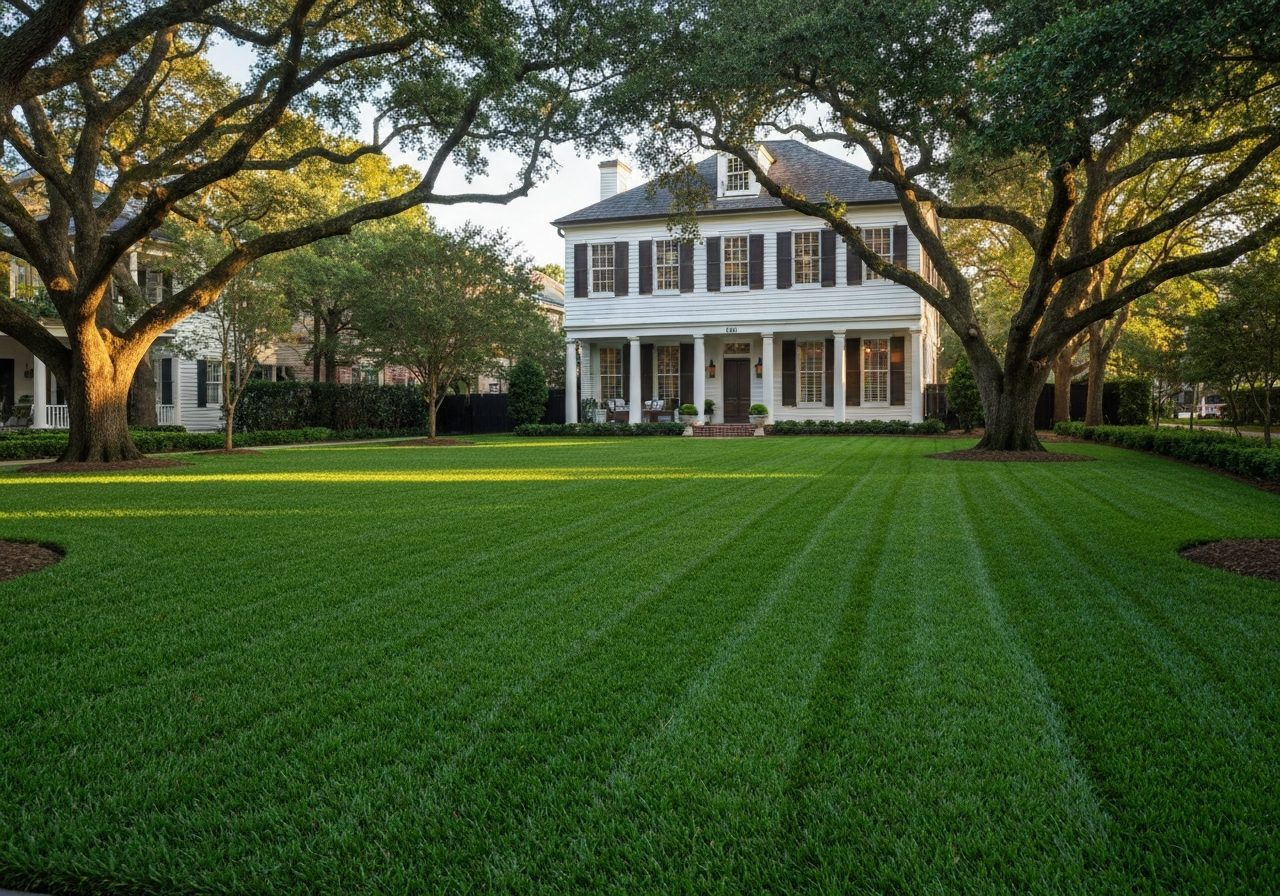
Last Updated: October 23, 2026
Table of Contents
- Should you resod the whole yard or just the dead sections?
- What percentage of damage usually means a full replacement?
- Why does the underlying cause matter more than the damage?
- When is partial resodding the right call?
- When is full replacement the right call?
- Will patch sod blend with the surrounding lawn?
- When is the best time of year for either option?
- Frequently Asked Questions
- Ready to get a quote on partial or full resodding?
Quick Summary: Partial resodding works when the damage sits in a few isolated sections and the underlying cause is fixed. Full replacement is usually the right call once 40 to 50 percent of the lawn is bare, weedy, or dying, or when the grass variety is wrong for the site. The decision rests on cause and extent more than on cost alone.
Should you resod the whole yard or just the dead sections?
The answer depends on how much of the lawn has gone and why. If damage sits in a few isolated patches and the rest is healthy, patching with fresh rolls saves money. If damage is spread across the yard or the whole lawn looks tired, a full resod usually earns its cost by resetting everything at once.
Underneath the dollar question is a diagnosis question: what killed the sections you can see. A patch job that skips the diagnosis often ends up as a second patch job six months later. Big Easy Sod handles both partial and full resod work across Greater New Orleans and the Northshore.
| Damage share | Pattern | Usual recommendation |
|---|---|---|
| Under 20% | Isolated patches, cause known and fixed | Patch |
| 20 to 40% | Several sections or wider damage | Partial resod the dead sections |
| 40 to 50% | Spread across the yard | Lean toward full replacement |
| Over 50% | Most of the yard failed | Full replacement |
What percentage of damage usually means a full replacement?
A rule many sod producers suggest is that once roughly half of the lawn is bare, weedy, or dying, full replacement tends to be more reliable than repeated patching. Below that threshold, patching usually makes sense. Above it, you are often chasing the same patches year after year.
The percentage is a guide, not a rule. A yard with 30 percent damage concentrated at the base of a slope that holds water usually needs regrading before any patch holds. A yard with 50 percent damage all under one tree that has since been removed can often do fine with partial work. Read the pattern, not just the total.
Why does the underlying cause matter more than the damage?
Fresh sod only roots on a site that can support grass. If a section died from standing water, poor drainage, pet urine, or shade, laying new sod without changing the cause gets a repeat failure. Patching after a one-time event is usually safe; patching the same spot that has died twice is usually a waste.
Before any resod work, walk the yard and name the cause for each damaged section. If you cannot name it, the honest answer is a diagnosis step first. The guide to reviving dying St. Augustine grass covers common causes on that variety, and similar logic applies to centipede, zoysia, and Bermuda.
When is partial resodding the right call?
Partial resodding earns its cost when damage is isolated, the rest of the lawn is healthy, and the underlying cause has been fixed. Common examples: one dog-urine patch, a strip killed by a since-repaired water line, or a corner that died under a since-removed tree. These are site-specific, finite problems.
The practical steps are the same as a full install but at a smaller scale. Cut out the dead section, fix the base, lay fresh rolls that match the surrounding grass variety, and water heavily for the first two weeks. For the full step-by-step on how a sod install goes together, our sod installation process walkthrough covers it.
When is full replacement the right call?
Full replacement is the right call when any of the following fits: more than roughly half the lawn is bare or weedy, the grass variety is wrong for the site, the grade needs a reset, or the soil needs serious correction. In those cases, patching ends up more expensive than a one-time resod and the yard still looks patchwork.
Full replacement is also the honest call when the client wants a fresh look. Patches rarely blend seamlessly, even when the variety matches, because the new sod and the surrounding lawn develop at different rates. For a sense of what a full resod costs, our sod replacement cost breakdown for New Orleans walks through the pieces.
Will patch sod blend with the surrounding lawn?
Patch sod usually looks different from the surrounding lawn for the first season. New rolls hold moisture differently and often green up at a different rate than the established grass. Many patches blend in by the end of the first growing season when the variety matches, though some texture and color difference can remain. A centipede patch in a St. Augustine lawn will stay visibly different.
Match the variety first, then match the cultivar if possible. If the previous sod was a specific zoysia cultivar like Zeon or Empire, a patch of mixed zoysia will still show. We ask what grass is on the yard before we quote patches for this reason.
When is the best time of year for either option?
Partial and full resodding both do best in warm, growing-season weather, usually late spring through early fall. Rolls dropped on warm soil root faster, which matters more for patches than full installs because a patch has established lawn around it that will out-compete the newcomer if the newcomer is slow to establish.
Fall and winter installs are possible, but establishment stretches into the following spring, and patches in particular can look sunken through dormancy. For either option, the best time to install sod in New Orleans guide walks the window month by month.
Frequently Asked Questions
How many pallets do I need for a partial resod?
Measure the total square footage of the dead sections and add about 10 percent for cuts and waste. A standard Big Easy Sod pallet covers around 450 to 500 square feet. For small jobs we can often sell by the roll rather than the pallet, call us at (504) 608-3321 to confirm minimums.
Can I patch with a different variety than the rest of the lawn?
You can, but it will look obvious year-round. Match the variety for patch work unless you are planning a staged full switch to a new grass.
Is reseeding ever a better option than patching with sod?
For warm-season lawns in Louisiana, usually no. St. Augustine cannot be seeded at all. Centipede and Bermuda can be seeded but establish slowly compared to fresh rolls.
What if the whole yard is going to need to be replaced in a year or two?
Then a patch now is often just a bridge, and a full resod sooner may make more sense than two rounds of expense. We will say so if we think a patch is going to look wrong inside the first season.
Ready to get a quote on partial or full resodding?
Whether the right call is a patch or a full reset depends on the yard, so a walkthrough is usually how we start. Send us the square footage, a photo of the worst sections, and the current grass variety and we will come back with a quote.